|
|
|
![]()
Successful
Listening, Speaking & Recall
Concrete Suggestions for Improving
Social Communication

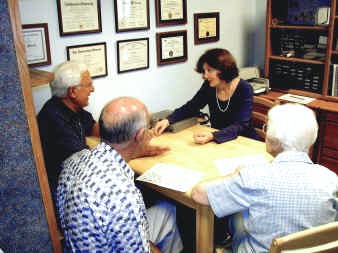
Michele Wilson, Ph.D., educating patients in her
Irvine office.
Suggestions for
improved listening
Suggestions for improved speaking so others can hear you
|
![]()
Ten Keys to Effective Listening
| Ten Keys to Effective Listening | The Bad Listener | The Good Listener |
| 1. Find areas of interest. | Tunes out dry subjects. | Opportunizes. Asks, "What's in it for me?" |
| 2. Judge content, not delivery. | Tunes out if delivery is poor. | Judges content, skips over delivery errors. |
| 3. Hold your fire. | Tends to enter into argument. | Doesn't judge until comprehension is complete. |
| 4. Listen for ideas. | Listens for facts. | Listens for central themes. |
| 5. Be flexible. | Takes intensive notes. | Takes fewer notes. |
| 6. Work at listening. | Shows no energy output. | Works hard, exhibits active body state. |
| 7. Resist distractions. | Is easily distracted. | Avoids distractions, tolerates bad habits, knows how to concentrate. |
| 8. Exercise your mind. | Resists difficult material. | Uses heavier material as exercise for the mind. |
| 9. Keep your mind open. | Reacts to emotional words. | Interprets color words. Does not get hung up on them. |
| 10. Capitalize on the fact that thought is faster than speech. | Tends to daydream with slow speakers. | Challenges, anticipates, summarizes, weighs the evidence, listens between the lines to tone of voice. |
![]()
Good Communication Strategies
Don't interrupt the speaker before he or she finishes a sentence. You may not understand the beginning, but may catch the end. When you are aware that you missed something that was said, ask that it be repeated. Summarize what you did hear so that your communication partner knows what to fill in. Learn about the topic being discussed. When you know what a person is talking about, it is easier to follow the conversation. Learn to look for ideas rather than isolated words. Keep alert for key words in sentences in order to follow ideas. Use the clues from the situation to help get meanings. The idea is often spelled out by the actual situation. You may be able to anticipate words or phrases that will probably be used. Don't be afraid to guess, using situational and contextual clues. Keep informed of your friends' interests. If you and your friends have favorite topics, this limited content makes understanding easier. Stay aware of current events. When you know something about a topic you can more readily recognize key words, names, and so forth. It will be helpful to read the daily newspaper and to be aware of the programs many people may watch, even if you don't watch TV. Ask family members to keep you informed about things that are happening in your community and neighborhood and about events in the lives of people you know. Keep your sense of humor. |
![]()
Successful
Communication for the
Hearing-Impaired Listener
Speak clearly and slowly. Don't clip word endings or mumble, and don't over-articulate your words. Stress key words and pause between statements. Use natural gestures and natural facial expressions. Avoid moving around while you talk. Speak at a distance of between three and six feet. Don't make the hearing-impaired person speech-read over excessive distances. Stand in clear light facing the person with whom you are speaking. This will make your lip movements, facial expressions, and gestures easier to see. Make sure you have the hearing-impaired person's attention and are clearly visible to him or her before you start speaking. Tapping the person on the shoulder or waving from a distance are acceptable methods for getting the person's attention. Move away from background noise. Rephrase what you have said when you think the hearing impaired person has misunderstood you. Look for clues, like facial expressions and inappropriate responses. Do not assume that you must restate everything, though. Do not obscure your mouth or chew food while speaking. Include the hearing-impaired person in the conversation. Tell the person the topic of conversation; don't force him or her to guess. Speak directly to, not about, the hearing-impaired person. In meetings or group activities where there is a speaker, strongly suggest that the speaker use the public address system. Arrange the room where communication will take place so that all the participants are completely visible to one another. Try to eliminate or diminish background noise. Ask the hearing-impaired person what you can do to make conversation easier. |
![]()
|
For more information, join our FREE weekly and monthly discussion groups on successful communication in Irvine and Lake Forest, CA. |
|
|
|
4010 Barranca, Suite 220 (at Culver),
Irvine, California 92604 |


